
Video Posts
The teachings below have been filtered to focus on 'Video Posts'.

When I am weak, He is strong!
The teaching focuses on how God’s strength becomes visible precisely where one feels weak, powerless and insignificant, and how He deliberately chooses the small and despised to shape them into useful instruments. It draws on examples from Gideon, Samson and David, who all had to recognise that their own strength and plans were not enough, but that true victory comes when they walk in faith and surrender to God, who lifts them up and acts through them. We are encouraged to break away from the ‘Jante Law’ and misunderstood humility, so that we can both thank God for the gifts and strength He has placed within us and at the same time give Him the glory, rather than living in pride or self-deprecation. We are encouraged to recognise our powerlessness without God, to make ourselves dependent on Him, to trust fully in the Bible as God’s Word, to let go of our own honour and control, and to act in faith, because we know that God is faithful and will do again what He has already done. The teaching shows how hope in the Lord is an active expectation, interwoven with God’s faithfulness and one’s own experiences with Him, and how that hope provides new strength and ‘springiness’, so that one gains perspective, sees other people’s stories, and can love and serve from God’s viewpoint rather than from one’s own self-centred perspective.
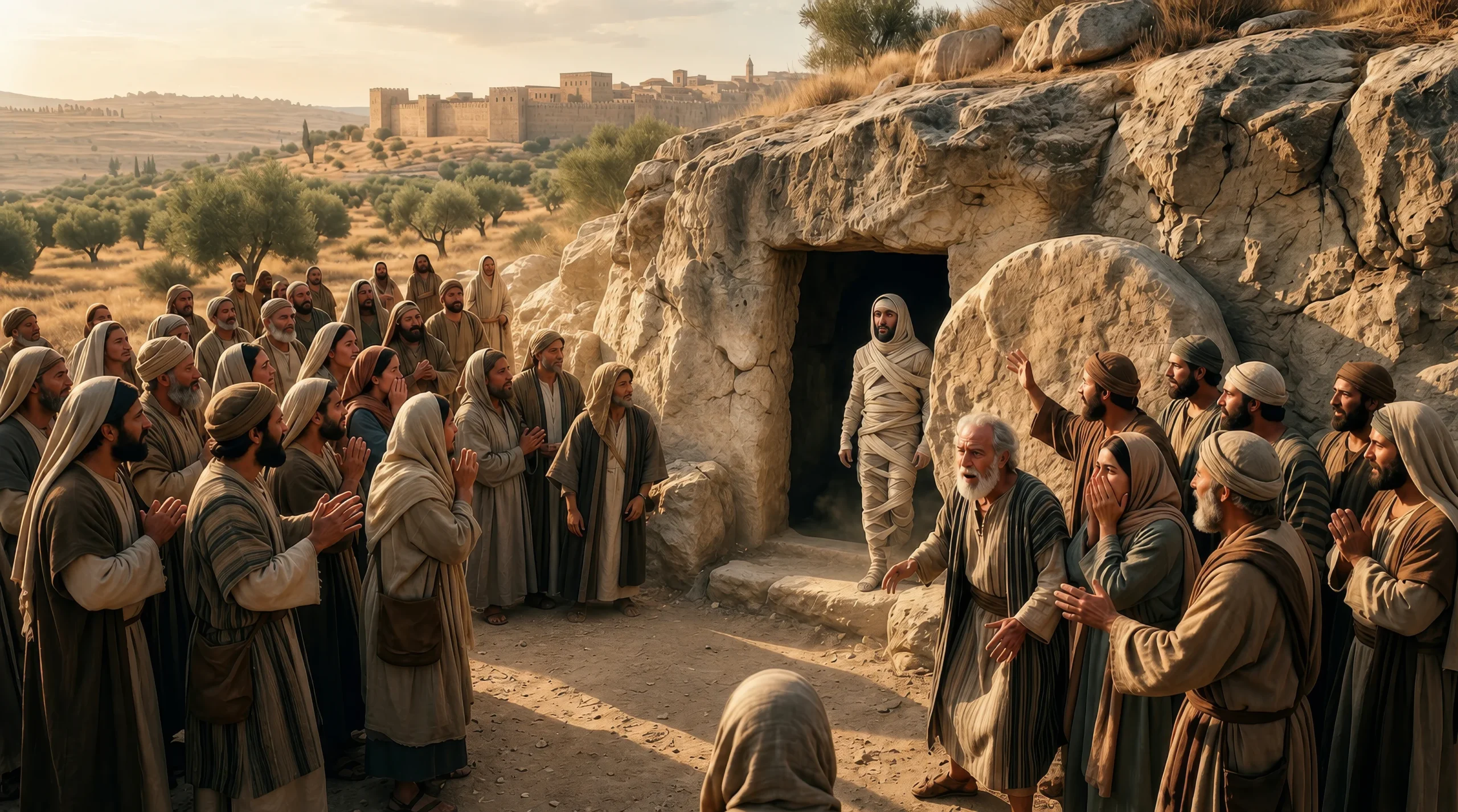
The story of Lazarus
The lesson goes through the story of Lazarus in the Gospel of John, chapter 11, verse by verse, and shows how Jesus meets disappointment, grief, doubt and scorn with both compassion and authority. Emphasis is placed on the fact that Jesus deliberately waits until Lazarus has been in the tomb for four days, in order to reveal God’s glory and to show whether there is faith that He truly is the resurrection and the life in the midst of a hopeless situation. We are encouraged to see ourselves reflected in Martha and Mary, who both believe and reproach, and to let Jesus call us by name out of the ‘graveyards’ of life where we have given up hope. At the same time, it is emphasised that the congregation has an important role in ‘unbinding’ those whom Jesus sets free, so that the bonds of the past do not continue to control the future.

God’s grace and the thorn in the flesh
The teaching explores in depth what Paul’s “thorn in the flesh” means, and how God’s grace is connected to both weakness, persecution and strength in everyday life. It is pointed out that the thorn in the flesh is not necessarily an illness, but rather persistent opposition, and that we must read the text in the light of the whole Bible’s testimony of healing, freedom and God’s goodness. We are encouraged to choose humility over pride, to act on our faith, and to see God’s grace as an active force that sustains us amidst pressure, trials and spiritual struggle. Emphasis is placed on the fact that God’s grace both saves, nurtures, equips and gives identity, so that we may live holy lives, remain in fellowship and stand firm when opposition comes.

A holy temple
The teaching unfolds what it means that our lives, our local congregation and the whole worldwide church are a holy temple for God. It discusses how Jesus has redeemed us, so that we no longer belong to ourselves, but are called to live as living sacrifices, using our bodies, time and energy to honour God in our daily lives. We are encouraged to live in a committed Christian community, where each individual is a living stone in God’s building, and where we bear, support and encourage one another rather than criticising. We are warned against lukewarmness, self-centredness and spiritual pollution through what we see, hear and fill ourselves with, and we are urged to let God cleanse and maintain the temple so that it may be a place where Jesus is the centre and people encounter His presence.

The long, hard haul for God’s kingdom
The lesson focuses on the long, hard slog in God’s kingdom and shows how the Christian life is a race that requires endurance, obedience and faithfulness over time. Images from sport, practical work and a number of biblical figures such as Noah, Abraham, Joseph, Moses, Isaiah, David and Samuel are used to show that God’s calling often involves long periods of silence, adversity and hard work without immediate results. It encourages us to hold fast to what God has once spoken, even when our emotions, body and surroundings say “give up”, and to see the time of shaping as an important part of God’s plan. The aim is to encourage people to ask God where they can make a difference for His kingdom, and to choose to keep running the race He has set before them, trusting that He will bless and use it.

When our prayers are not heard
The teaching explores why prayers are sometimes experienced as blocked, even when there is faith and prayer in one’s life. It highlights a number of biblical areas that can hinder answered prayer, such as deliberate sin, hard hearts, lack of forgiveness, broken relationships, neglect of the poor, hypocrisy in prayer and unfaithfulness in marriage. We are encouraged to allow God to examine our motives, conscience and relationships, to seek reconciliation, to live in repentance, and to let our hearts be completely honest and engaged in prayer. The aim is not to induce a guilty conscience, but to open a path to a stronger prayer life, where there is boldness before God, and where prayers are not merely spoken, but are also heard and answered.

A whirlwind of thoughts – When thoughts are queuing up
The teaching addresses the whirlwind of thoughts and worries, showing how recurring thoughts about the past, the future, identity, health and the world can bind us and drain our joy. It highlights the Bible’s call to break down strongholds of thought, take thoughts captive in obedience to Christ, and renew the mind through God’s Word, rather than being controlled by fear and negative patterns. It encourages us to make a conscious choice not to live in worry, but to plan and act responsibly with trust in God, and to let Jesus be the commander, whose words carry more weight than our own or others’ thoughts. The focus is on rejoicing in the Lord, bringing one’s desires to God in prayer, allowing God’s peace to guard one’s heart and mind, and going out to bear fruit, so that faith becomes not merely words, but a life of obedience and trust.

Firstfruits
The teaching explores what the firstfruits mean in the Bible, from the Law of Moses, Abraham and Melchizedek to Jesus as the firstborn, and shows how this principle still speaks powerfully today. It is pointed out that this is not merely about tithing and finances, but about God receiving the first and best of our time, resources, love and attention, whilst we live in a shared economy with Heaven. We are encouraged to let the Holy Spirit guide us in our giving, so that it is not about forcing ourselves to meet a target, but about living with a generous heart, where sacrifice is truly felt. At the same time, there is a warning against prosperity theology and self-focus, and emphasis is placed on the fact that the true goal is to put God’s kingdom first, bless others and trust in His provision when we give the first to Him.

God’s fundamental peace
The teaching is about God’s fundamental peace and why many believers still walk around with anxiety, even though they believe in Jesus. The focus is on how fear, shame, control, old ways of thinking and a lack of trust in God steal the peace from our hearts. We are encouraged not just to know God’s Word in our heads, but to act on it in our daily lives and trust that His promises apply to us personally. At the same time, it becomes clear that peace often grows when our gaze shifts away from ourselves and towards service, love and obedience to God. We are called to let the peace of Christ reign in our hearts, so that life is not governed by worries, but by trust, calm and closeness to Jesus.

Love your neighbour
The teaching focuses on what it actually means to love one’s neighbour as oneself, and why this is absolutely central to the Kingdom of God. It shows how love for one’s neighbour is not based on feelings, but on a self-sacrificing love that chooses to act for the sake of the other, even when it comes at a cost. We are encouraged to see our neighbours not only as those in our own ‘group’, but as the people God places in our path in everyday life. It becomes clear that helping the weak, vulnerable and overlooked is taken very seriously by God, as if it were done to Jesus himself. We are called to pray to be shown who our neighbour is, and to live with openness, generosity and obedience, even when there is no thanks or reward.

Speaking in tongues… what on earth is that?
The teaching addresses speaking in tongues by going through the Bible chronologically and looking at what it actually says on the subject. From Jesus’ own words in the Gospel of Mark that certain signs will follow those who believe, to the dramatic unfolding of the Day of Pentecost, when the Holy Spirit comes upon the disciples. The difference between the various types of speaking in tongues is explained – both the public kind, which is to be interpreted in the congregation, and the personal kind, which builds up our own spiritual life. We are encouraged to actively seek the spiritual gifts and not to let pride or false expectations prevent us from receiving what God wants to give. Speaking in tongues is not something that died with the apostles, but a sign that is to follow all believers until Jesus returns.

Break down demonic strongholds
The teaching focuses on identifying and breaking down demonic strongholds, which are thought patterns and lies that the devil builds up in our minds. It explains how the devil uses feelings of inferiority, illness, pride, religiosity, control and fear to isolate us from God and prevent us from living to our full potential. Practical advice is given on how we can actively break down these strongholds through sanctification, humility, God’s Word and concrete actions that demonstrate our decision to believe God’s truth rather than the devil’s lies. We are encouraged to make life choices together with God to put off the old self and renew our minds, so that we may live in freedom and be a threat to the devil’s kingdom.