

The teaching takes its starting point in the story of Lazarus in the Gospel of John, chapter 11, as a profound and very practical illustration of who Jesus is, how He meets people’s grief, doubt and disappointment, and how He brings life forth where, humanly speaking, all hope is dead and buried. We follow the entire narrative verse by verse and see how a seemingly “classic miracle story” contains far more layers concerning identity, trust, discipline, fellowship and discipleship than one might realise at first glance. “Teacher’s name here” explains how Lazarus, Martha, Mary, the disciples, the Jews around them and the religious leaders all reflect some of the struggles we face today as we endure waiting, crises, despair and the struggle to believe that Jesus truly is the resurrection and the life – in the midst of our ordinary everyday lives.
First, the text itself is read: “There was a man who was ill; his name was Lazarus, and he was from Bethany, the village where Mary and her sister Martha lived. It was Mary who anointed the Lord with fragrant oil and wiped his feet with her hair, and it was her brother Lazarus who was ill. The sisters now sent this message to Jesus: ‘Lord, the one you love is ill’” (John 11:1–3). Already here, the emphasis is placed on the fact that Lazarus’ identity is not primarily defined by all that he has done, but by the love Jesus has for him: ‘the one you love’. This becomes a key to the whole teaching: when we come to Jesus with our distress, it is as those He loves – not as someone who must first prove something or explain everything in detail. Reference is also made to the name Bethany, “the house of the poor”, and to the fact that Jesus shows time and again that He has come precisely to the poor, the bound and the despairing to set them free.
Then comes what, from a human perspective, seems completely illogical: Jesus loves Martha, Mary and Lazarus, but when He hears that Lazarus is ill, He remains where He is for two more days before setting off. The teaching focuses sharply on this paradox: if you truly love someone and know that you can help, wouldn’t you rush off immediately? There is an honest discussion of the disappointment Martha and Mary must have felt when Lazarus first died, was then buried, and had even been in the tomb for four days, whilst Jesus still had not appeared. This is linked to our own experiences of having sent out the message: “Lord, the one you love is ill”, “Lord, you see my problem”, and yet it seems as though Jesus is taking his time. Instead of simply explaining it away, we are allowed to feel their disappointment and reproach – and at the same time see that Jesus always has a broader perspective: the illness is to serve God’s glory.
The disciples quickly come to represent human logic and the instinct for self-preservation. They remind Jesus that the Jews have just wanted to stone Him, and cannot understand why on earth He wants to return to Judea. Jesus responds by saying that the day has twelve hours, and that whoever walks by day does not stumble, because he sees the light of this world. The teaching links this to Jesus’ words later: “I am the light of the world. Whoever follows me shall never walk in darkness, but shall have the light of life’ (John 8:12) and points out that Jesus’ focus is not on securing His own safety first, but on doing the Father’s will whilst there is still time. We are encouraged to see that when we walk with Jesus, we walk in the light, and so it is not fear and risk that should guide our choices, but obedience to His call – even when those around us say “don’t do it, it’s too dangerous or too foolish”.
In the midst of it all comes the honest and down-to-earth misunderstanding: Jesus speaks of “our friend Lazarus sleeping”, and the disciples immediately think of ordinary sleep, where one is, of course, recovering. Here Jesus shows just how patient He is when He has to spell it out: “Lazarus is dead”, and that He is actually glad He wasn’t there, “so that you may believe”. The lesson uses this to show that even the closest disciples often do not understand what Jesus is doing until afterwards – and that gives us hope when we, too, do not understand God’s timing and must make do with a single clear sentence amidst all that does not make sense: “Lazarus is dead … but let us go to him.” Thomas’s comment is also highlighted: “Let us go too, so that we may die with him.” This is interpreted as a mixture of misunderstanding, courage and a rather wild decision: When Jesus goes, we go – even if it seems to cost us our lives. That determination is held up as a model of discipleship, even though Thomas later becomes known for doubting the resurrection.
When Jesus finally arrives in Bethany, the grief is palpable. Lazarus has been dead for four days, and many Jews have come to comfort Martha and Mary. In the teaching, attention is drawn to the difference in the two sisters’ reactions: Martha goes out to meet Jesus, whilst Mary remains sitting inside the house. It is suggested that Mary is probably so hurt and disappointed that she cannot even bring herself to go out to Him who could have prevented all this. Martha, on the other hand, goes out to meet Jesus with both faith and reproach in the same sentence: “Lord, if you had been here, my brother would not have died. But even now I know that whatever you ask of God, God will give you.” It is described as a mixture of honest grief and a faith that both wants to and cannot at the same time. We know the feeling when we say the right things about God’s omnipotence, but inside we think, “It’s too late.”
Jesus answers Martha with a simple and clear statement: “Your brother will rise again.” She hears this in a purely theological sense and responds with the doctrine of the resurrection on the last day: “Yes, I know that he will rise again at the resurrection on the last day.” Here Jesus broadens the perspective and speaks the words that are central to his teaching: “I am the resurrection and the life. Whoever believes in me will live, even though they die. And whoever lives and believes in me will never die for ever. Do you believe this?” (John 11:25–26). There is a bit of play on how Martha answers “indirectly”, by confessing that she believes He is the Christ, the Son of God, but does not directly answer the question. This is used to reflect our own tendency to respond with fine declarations of faith when Jesus is actually asking whether we believe that He is, here and now, the resurrection within our concrete, stinking grave-like situation.
When Mary finally goes out to Jesus, she falls at His feet – an expression of awe, worship and recognition of who He is – but the words that come out of her mouth are exactly the same reproach as Martha’s: “Lord, if you had been here, my brother would not have died.” The lesson highlights the duality we often experience: we bow before Jesus as Lord, weep at His feet, yet at the same time we writhe in disappointment and fail to understand His timing. Jesus meets their tears with a strong emotional reaction: He is “deeply moved” and bursts into tears. It is explained that the Greek word conveys both deep emotion and a kind of inner anger or indignation. On the one hand, He sees their grief and weeps with them as a fully human being who loves His friend and their family; on the other hand, it pains Him to see the lack of trust and the scorn that also lies in comments such as: “Could not he who opened the eyes of the blind have also kept Lazarus from dying?”
When Jesus commands that the stone be rolled away, Martha’s practical, human concern resurfaces: “Lord, he is already stinking; he has been there for four days.” It is taught that at that time the tomb was a ritually unclean place, that contact with the dead required purification according to the law, and that the Jews held the belief that the soul “remained around the body” for three days, but was definitely gone thereafter. So, in practice, Jesus chooses a moment when no one can suspect a misdiagnosis or a ‘near-death experience’; there is no way back, no hope left – this makes the miracle itself significantly more powerful. At the same time, He confronts Martha directly: “Have I not told you that if you believe, you will see the glory of God?” And here she actually acts on her faith: the stone is rolled away, despite the stench, despite the risk of social embarrassment and religious criticism. It is made clear that faith in practice often involves doing something concrete and visible, which could become deeply embarrassing if God does not intervene.
Then Jesus looks up to Heaven and thanks the Father, because He knows that the Father always hears Him. It is emphasised that Jesus deliberately prays aloud ‘for the sake of the crowd’ – so that they may hear that He is not acting on His own, but as the One whom the Father has sent. The focus shifts from the miracle itself to the relationship between the Father and the Son: Jesus does everything in the Father’s will and gives all glory to Him. It is also used to encourage the listener to trust that when Jesus prays for us, He prays as one who knows that the Father always hears, and His words carry weight and authority over any life-threatening situation we face.
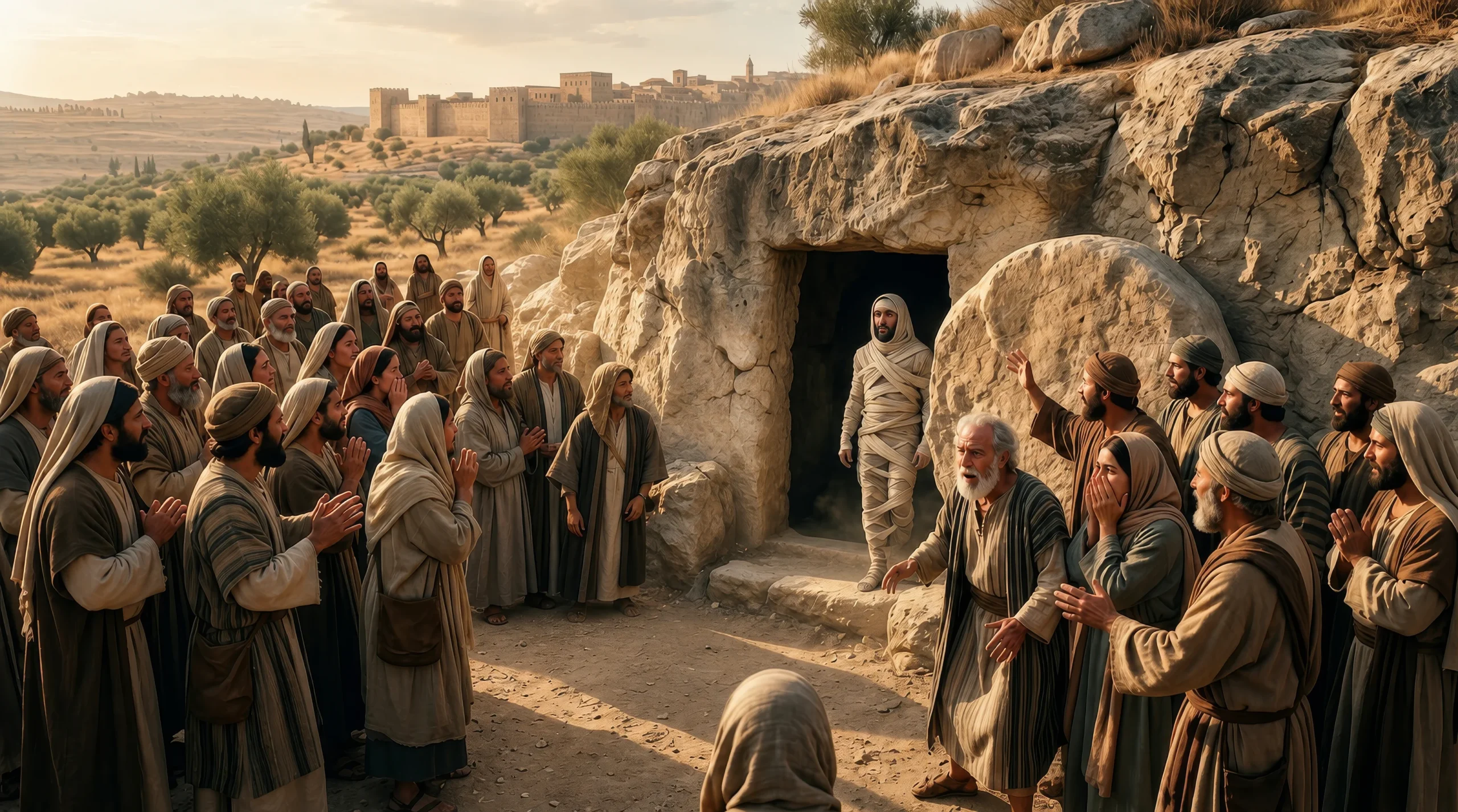
Then comes the moment when everything comes into sharp focus: Jesus cries out in a loud voice: “Lazarus, come out!” The teaching describes it almost cinematically: the stench that pours out, the weeping, the shouting, some whispering that He is mad, others standing in tense silence, almost holding their breath. Jesus’ words are said to ‘cut through’ the crowd and into the tomb, and it is pointed out that when Jesus calls, death, darkness and spiritual powers are forced to let go; they have no right when He speaks. Lazarus comes out, still wrapped in linen cloth, with a cloth over his face, and emphasis is placed on Jesus’ words: “Unbind him and let him go.”
That very sentence unfolds as a powerful image of discipleship and the church’s task. Jesus raises Lazarus from the dead – no one else can do that – but He does not choose to unwrap the strips from him Himself. He leaves that to those standing around. There is talk of how people who are set free are often still bound by old ties, thought patterns, relationships and words that others have spoken over them. Some are physically healed but still live in environments that speak sickness and defeat over them. Here, Jesus calls his disciples to ‘unbind’ one another – to help one another out of old bonds, to point to the new identity, to pray, to teach, to support, to walk together, and not simply to leave one another entangled in the ‘shrouds’ of the past. Lazarus becomes a symbol of every believer called out of the tomb with a new identity: from “the one who is sick or dead” to “the one who was dead but is now alive”.
The teaching continues into chapter 12, where we see what happens after the miracle: a feast is held, Lazarus sits at table with Jesus, Martha serves, and Mary anoints Jesus’ feet with precious nard oil and wipes them with her hair. It is pointed out how powerful it is that Mary, who was previously so disappointed, is now the one who, in deep love and adoration, gives the most precious thing she has to Him who actually allowed her brother to die – only to raise him up again. At the same time, we are told that the chief priests now also want to kill Lazarus, because many Jews are coming to believe in Jesus because of him. This paints a stark picture: when Jesus truly intervenes in a person’s life, so that it becomes a living testimony, it arouses both faith and fierce opposition. It is said that letting Jesus come very close and transform one’s life can come at a cost – there may be relationships that turn against you, or opposition that arises, precisely because you have become visible proof of God’s power.
In the end, it all comes together with a powerful call to action. The story of Lazarus is not just an old tale of a man who was once dead and came back to life. It becomes a mirror for us: Where in our lives are there areas that have been ‘laid in the tomb’ – dreams, callings, relationships, faith – that we have wrapped up and rolled a stone in front of, because we think that now it is too late, now it smells too much, now all hope is dead? The teaching encourages us to listen for the voice of Jesus calling us by name out of the grave, and to embrace the community that will help remove the “linen cloth” – through baptism, intercession, teaching, fellowship, forgiveness and practical help. We are urged not to give up, even when answers to prayer are slow in coming, but instead to hold fast to what God has said and believe with our whole being – not just with our heads, but with heart, soul and body – that Jesus is not too late, even when everything human seems hopeless. It concludes by pointing out that the greatest miracle is not merely that Lazarus came out of the tomb one day, but that Jesus Himself went to His death so that we might rise to a whole new life together with Him – now and for eternity.
Quote from the teaching: When Jesus calls you out of the tomb, then death, darkness and all bonds must let go, for His word pierces the stone, enters the dead and creates life where you thought all was lost.
Relevant keywords: The raising of Lazarus – the story of Lazarus – Jesus’ resurrection and life – disappointment and faith – Martha and Mary – the stone rolled away – untie him and let him go – new identity in Christ – hope when all is dead – God’s timing – answered prayer and waiting – discipleship and fellowship – life after death – everyday miracles – Jesus calls by name